
The POD Opportunity Most Entrepreneurs Still Ignore
Discover the POD opportunity most entrepreneurs still ignore in 2026. Learn how Print on Demand, automation, and global marketplaces allow you to build scalable online businesses without inventory, warehouses, or upfront risk using platforms like Etsy, eBay, Google Shopping, and Soocommerce.


The POD Opportunity Most Entrepreneurs Still Ignore
Many people think the e-commerce market is already saturated, especially in Print on Demand (POD). However, the reality is quite different. While thousands of entrepreneurs compete in visible niches, a much larger opportunity remains overlooked: building structured, brand-driven POD businesses powered by automation, niche targeting, and global marketplace integrations.
The POD opportunity most entrepreneurs still ignore is not just about selling products—it’s about building scalable digital brands without inventory, warehouses, or traditional operational barriers. With modern systems, anyone can launch a global e-commerce business from scratch using only designs, creativity, and the right infrastructure.
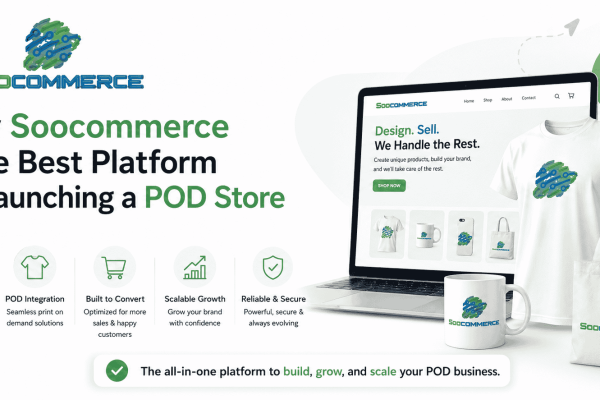
Today, platforms like Soocommerce are making it easier than ever to turn ideas into fully automated online stores that sell worldwide.
This shift is quietly reshaping global e-commerce, but many entrepreneurs still fail to recognize how powerful and accessible this model has become.
Why the POD Opportunity Is Still Ignored
Despite its growth, Print on Demand is often misunderstood or underestimated. Many entrepreneurs assume it is “too competitive” or “too simple to be profitable.”
Misconception: POD Is Saturated
One of the biggest myths is that the POD market is overcrowded. While competition exists in broad niches, most sellers fail to go deeper into:
- micro-niches
- emotional identity branding
- community-based product lines
This creates massive untapped potential.
Lack of Strategic Positioning
Many beginners focus only on products instead of building brands. They upload random designs without:
- consistent identity
- storytelling
- niche targeting
As a result, they fail to differentiate.
Underestimating Automation Power
Modern POD is not manual anymore. Yet many entrepreneurs still imagine it as:
- time-consuming fulfillment
- manual order handling
- complex logistics
In reality, automation has completely changed the game.
What Print on Demand Really Means in 2026
Print on Demand is no longer just a “side hustle model.” In 2026, it has evolved into a full-scale digital business infrastructure.
The Core System Behind POD
At its core, POD works through a simple automated flow:
- A design is created
- The design is uploaded to a store
- A customer places an order
- The product is produced automatically
- Shipping is handled by fulfillment partners
No inventory is required at any stage.
POD as a Brand-Building Engine
Modern POD is less about products and more about:
- identity-driven branding
- niche community building
- visual storytelling
The product becomes a medium for expression, not just a physical item.
Digital Ownership Over Physical Inventory
Instead of owning stock, entrepreneurs own:
- designs
- storefronts
- brand identity
- customer data
This shift makes POD fundamentally different from traditional retail.
Why the Entry Barrier Is Lower Than Ever
One of the biggest hidden advantages of POD today is how accessible it has become.
No Inventory Requirement
Traditional businesses require upfront investment in:
- stock
- warehouses
- storage systems
POD removes all of these.
No Logistics Management
Shipping, packaging, and fulfillment are no longer handled by the seller. This eliminates:
- operational complexity
- shipping errors
- warehouse costs
Global Selling From Day One
With marketplace integrations, sellers can access global customers immediately through:
- Etsy
- eBay
- Google Shopping
This means a beginner can reach international buyers from day one.
Example Scenario
A designer in a small city can:
- create 10 niche designs
- upload them to a store
- integrate marketplaces
- start selling globally within days
This level of accessibility did not exist in traditional business models.
Marketplace Integration and Automation Ecosystem
The real power of POD is not just production—it is distribution.
Etsy: Niche and Emotional Buyers
Etsy is ideal for:
- personalized products
- wedding designs
- emotional gifts
- niche communities
It rewards creativity and storytelling.
eBay: Global Reach Expansion
eBay provides:
- international exposure
- broad category flexibility
- scalable traffic sources
It helps diversify income streams.
Google Shopping: Search-Based Sales
Google Shopping connects products directly with buyer intent.
Example searches:
- “custom hoodie gift”
- “personalized mug design”
- “wedding sneakers unique”
This creates high-conversion traffic opportunities.
Automation Layer With Soocommerce
The backend infrastructure is where scalability happens.
Soocommerce enables:
- automated store creation
- marketplace integrations
- SEO optimization systems
- order fulfillment automation
This reduces technical complexity and allows entrepreneurs to focus on branding instead of operations.
Print on Demand vs Traditional Business Model
Understanding the difference highlights why POD is such a powerful opportunity.
| Feature | Print on Demand | Traditional E-Commerce |
|---|---|---|
| Inventory | Not required | Required upfront |
| Startup cost | Low | High |
| Risk level | Low | High |
| Scaling speed | Fast | Slow |
| Product testing | Easy | Expensive |
| Global reach | Immediate | Complex |
Key Advantage: Flexibility
POD allows rapid testing of:
- new niches
- design styles
- customer interests
Traditional models cannot adapt this quickly.
Key Disadvantage: Competition
However, competition exists in visible niches. The real opportunity lies in:
- underserved micro-niches
- emotional identity branding
- trend-based design cycles
Common Mistakes Entrepreneurs Make in POD
Most failures in POD are not due to the model, but execution mistakes.
1. Ignoring Niche Depth
Many sellers choose broad niches like:
- “fitness”
- “pets”
- “travel”
Instead of focusing on micro-audiences such as:
- “dog rescue volunteers”
- “marathon beginners”
- “solo female travelers”
2. Weak Branding Strategy
Random designs without a brand identity lead to:
- low customer retention
- weak recognition
- poor conversion rates
3. Poor Product Presentation
Even strong designs fail if:
- mockups are low quality
- descriptions are weak
- SEO is ignored
4. No Long-Term Content Strategy
Successful POD brands treat stores like media assets, not catalogs.
Checklist to Capture the POD Opportunity
Before launching a POD business, review this structured checklist:
Business Foundation Checklist
- Define a micro-niche clearly
- Build a consistent brand identity
- Create 10–30 initial designs
- Optimize product SEO descriptions
- Prepare marketplace integrations
- Set up automated fulfillment systems
- Ensure mobile-friendly store design
- Build a basic marketing plan
- Test 2–3 product categories
- Track performance metrics
Growth Checklist
- Expand winning designs
- Remove underperforming products
- Scale advertising gradually
- Improve SEO rankings
- Build social media presence
How Soocommerce Unlocks the POD Opportunity
Scaling a POD business requires more than design—it requires infrastructure.
Soocommerce plays a key role in simplifying this process by offering:
Ready-to-Launch Store Systems
Entrepreneurs can launch:
- fully designed e-commerce stores
- optimized product structures
- integrated payment systems
Automation-First Infrastructure
This includes:
- order processing automation
- fulfillment coordination
- marketplace synchronization
SEO and Marketplace Optimization
Stores are structured for visibility across:
- Google search
- Etsy listings
- eBay catalogs
- Google Shopping feeds
This reduces the need for technical expertise.
Why This Opportunity Is Still Wide Open
Despite growth in POD, most entrepreneurs still fail to approach it strategically.
The Real Gap in the Market
The gap is not in products—it is in:
- branding execution
- niche precision
- automation adoption
- long-term strategy
Early Movers Still Win
Even in 2026, early adopters in micro-niches can:
- build strong authority
- dominate specific segments
- scale globally faster
The Future of POD Opportunity
The POD industry is moving toward:
1. Hyper-Personalization
Customers want:
- unique identities
- custom expression
- emotional connection
2. AI-Assisted Design
AI tools will:
- speed up design creation
- optimize listings
- enhance marketing
3. Fully Automated E-Commerce Systems
Manual work will continue decreasing as automation improves.
FAQ
Is the POD market still profitable in 2026?
Yes. Profitability depends on niche selection, branding strategy, and execution quality rather than market saturation.
Do I need inventory to start a POD business?
No. POD works without inventory because products are created after orders are placed.
What is the biggest opportunity in POD today?
Micro-niche branding and automated global selling systems remain the most overlooked opportunities.
Which platforms are best for POD sales?
Etsy, eBay, and Google Shopping are among the most effective for global reach.
Why do most POD businesses fail?
Most failures come from weak branding, poor niche selection, and lack of SEO strategy.
How does Soocommerce help POD entrepreneurs?
Soocommerce provides automation, store setup, marketplace integration, and SEO optimization for scalable POD businesses.
Share this post:
Artículos Relacionados

Ready to start your Print on Demand journey? Discover how Soocommerce helps entrepreneurs launch a p...
Discover why thousands of entrepreneurs are switching to Print on Demand eCommerce. Learn how this l...
Ready to launch your dream Custom Products Store? Discover how Soocommerce helps entrepreneurs build...